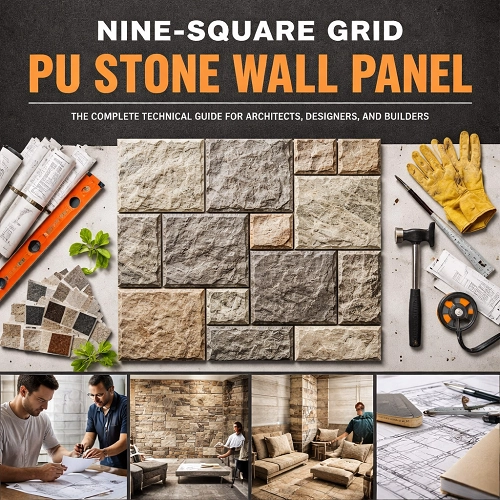
The Nine-Square Grid PU Stone Wall Panel represents one of the most technically refined entries in modern lightweight cladding. Combining high-density polyurethane engineering with authentic stone aesthetics, this panel challenges the dominance of real stone and cement board in both residential and commercial construction — delivering equivalent visual impact at a fraction of the weight, cost, and installation time.
The Nine-Square Grid PU Stone Wall Panel is a decorative architectural cladding product manufactured from high-density polyurethane (PU). Each panel features a structured nine-block grid pattern that replicates the appearance of individual masonry stones arranged in a 3×3 layout — producing the visual depth and texture of natural stonework without any of its structural limitations.
Produced by Haining Bingochic Decoration Material Co., Ltd., headquartered at No. 8 Feng Road, Shuangfeng Village, Yuanhua Town, Haining City, Zhejiang Province, China, the D-series panel line occupies a premium position within the company's broader PU Stone product range — which extends from the A-series through the L-series to address a wide variety of surface patterns and project requirements.
Unlike veneer tiles or painted surfaces, the PU stone panel is a monolithic, three-dimensional molded product. Its surface relief is an integral part of the panel structure — not an applied coating — which gives it significantly superior durability and dimensional stability over time.
Polyurethane is a polymer formed through the reaction of isocyanates with polyols. In its rigid, high-density form, it produces a closed-cell foam matrix that offers an exceptional combination of properties rarely found in a single material:
These properties explain why polyurethane has become the material of choice for premium faux stone cladding — and why Bingochic's D-series Nine-Square Grid panels are engineered around it.
The table below summarizes the key technical parameters of the Nine-Square Grid PU Stone Wall Panel (D-series). Specifications can be customized to match project requirements — contact Bingochic's technical team for bespoke sizing.
| Parameter | Standard Value | Notes |
|---|---|---|
| Primary Material | High-Density Rigid Polyurethane (PU) | Closed-cell foam matrix |
| Panel Dimensions | 1200 × 600 mm (D001–D008) | Custom sizes available |
| Panel Thickness | 30 mm | Includes surface relief depth |
| Approximate Panel Weight | 1–2 kg per panel | vs. ~50–70 kg for real stone equivalent |
| Surface Finish | Multi-layer stone-imitation coating | Matte, sandstone, gray, beige, naturals |
| Water Absorption Rate | <1% | Suitable for humid/semi-exterior use |
| Operating Temperature Range | −40°C to +80°C | Stable in tropical and cold climates |
| UV Resistance | High | Anti-fade surface coating |
| Fire Rating | Fire-retardant (industry standard) | Non-toxic formulation |
| Installation Method | Adhesive + mechanical fastening | Interlocking tongue-and-groove edges |
| Cuttability | Standard hand tools / circular saw | No specialist tools required |
| Maintenance Requirement | Minimal — wipe clean | No sealing or grouting required |
The D-series currently comprises eight distinct SKUs, each sharing the same 1200×600×30 mm form factor while offering a different stone pattern, grain direction, or surface color. This consistency in dimensions simplifies project logistics: installers can mix pattern variants across the same wall without any dimensional mismatches.
For architects working on large-scale projects, Bingochic also offers panels across its A-series, B-series, C-series, and beyond — each engineered for a specific aesthetic profile, from rough quarry stone to smooth ashlar masonry.
Specifying the right cladding material requires a clear-eyed look at performance trade-offs. The table below compares the Nine-Square Grid PU Stone Wall Panel against natural stone veneer and fiber-reinforced cement board across the most critical project parameters.
| Criterion | PU Stone Panel (D-Series) | Natural Stone Veneer | Cement Board |
|---|---|---|---|
| Weight (per m²) | ~2.8 kg/m² | ~50–80 kg/m² | ~12–20 kg/m² |
| Thermal Insulation (λ) | ~0.025 W/(m·K) | ~2.0–3.5 W/(m·K) | ~0.35 W/(m·K) |
| Water Absorption | <1% | 0.4–5% (type-dependent) | 10–15% |
| Installation Skill Required | Low — DIY-friendly | High — specialist mason | Medium |
| Structural Support Required | Standard wall substrate | Reinforced substrate often needed | Standard wall substrate |
| Customization / Cutting | Easy — hand tools or saw | Difficult — wet saw, specialist cuts | Moderate |
| Maintenance | Wipe clean, no sealing | Periodic sealing and re-grouting | Painting required over time |
| UV / Fade Resistance | High (coated surface) | High (inherent material) | Moderate (dependent on paint) |
| Relative Material Cost | Low–Medium | High–Very High | Low |
| Aesthetic Authenticity | Very High | Highest (real stone) | Low (painted finish) |
One of the defining commercial advantages of the D-series panel is its installer-friendly design. The interlocking tongue-and-groove edges eliminate the need for specialist tools or skilled tradespeople in most applications.
The substrate must be structurally sound, dry, and free of dust, grease, or loose material. For exterior installations, ensure any existing paint or coating has adequate adhesion. Apply a primer coat if the wall surface is highly porous (e.g., bare concrete or brick) to improve bonding of the construction adhesive.
Snap horizontal and vertical chalk lines across the entire installation area before applying any panels. Because the nine-square pattern has a defined orientation, consistent alignment is critical for achieving a natural masonry appearance. Start from the most visually prominent corner and work outward.
Cut panels to size using a utility knife for thin-profile cuts, or a circular saw fitted with a fine-tooth blade for cleaner through-cuts. The PU matrix cuts cleanly without chipping or cracking — a major advantage over ceramic tile or natural stone, which require wet-saw equipment and produce brittle edges.
Apply a compatible construction adhesive (polyurethane- or acrylic-based) across the rear face of each panel in a serpentine bead pattern. Press firmly onto the substrate and hold for 30–60 seconds. For exterior or high-humidity environments, supplement the adhesive bond with corrosion-resistant mechanical fasteners (screws) driven through concealed areas near panel edges.
The interlocking panel edges create tight, near-invisible seams. For exterior applications or any installation where moisture ingress is a risk, fill perimeter seams and penetration points with a color-matched flexible sealant. No grouting is required within the panel body — the simulated mortar joints are part of the molded surface relief.
Routine maintenance requires only a damp cloth or soft brush. Avoid highly abrasive scourers or solvent-based cleaners, which may degrade the surface coating. For exterior panels, inspect mechanical fasteners annually in high-wind zones.
| Application | Environment | Recommended D-Series Use |
|---|---|---|
| Living room feature wall | Interior / dry | Full wall or accent panel behind TV / fireplace |
| Hotel lobby cladding | Interior / high-traffic | Reception desk surround, pillar wrapping |
| Restaurant / café wall | Interior / humid | Branded feature wall, open-kitchen backdrop |
| Residential exterior façade | Exterior / exposed | Full façade cladding, porch columns |
| Garden / courtyard wall | Exterior / semi-exposed | Boundary wall, outdoor entertainment zone |
| Prefab / modular building | Exterior / structural weight-sensitive | Full panel cladding on modular frames |
| Retail shopfront | Semi-exterior / branding-critical | Entrance surround, display area accent |
| Office entrance | Interior / professional | Lobby wall, branded statement surface |
For complete room-by-room design guidance, Bingochic publishes dedicated solution pages covering living room solutions, kitchen solutions, bathroom applications, and more.
Compliance with fire safety and environmental standards is non-negotiable in modern construction. The Nine-Square Grid PU Stone Wall Panel is manufactured to meet the following performance benchmarks:
Haining Bingochic Decoration Material Co., Ltd. is a vertically integrated manufacturer based in Haining, Zhejiang — one of China's primary decorative materials manufacturing hubs. The company controls the entire production process from raw material sourcing and mold design through coating, quality inspection, and logistics, enabling it to maintain consistent tolerances across large-volume orders.
Beyond the PU Stone range, Bingochic's product portfolio spans PVC Panel, SPC Flooring, Integrated Wall Panels, 3D PVC Wall Panels, and Foaming Solid Boards — making it a single-source supplier for complete interior and exterior envelope solutions. This breadth simplifies procurement for developers and contractors managing complex, multi-surface projects.
The company serves a global client base including real estate developers, architectural studios, hospitality groups, prefab building manufacturers, and retail chains. For frequently asked questions about products, lead times, and customization, visit the Bingochic FAQ page, or stay current with product and industry developments through the industry news section.