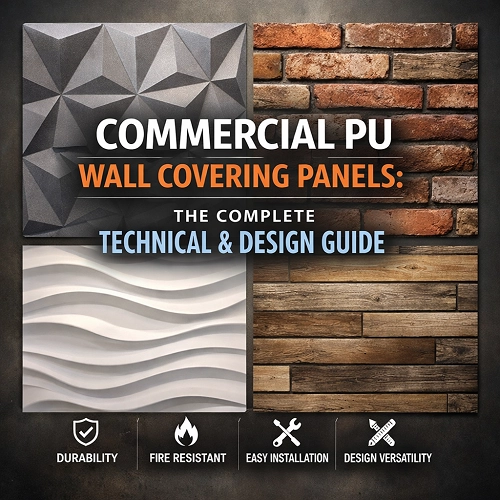
Commercial PU Wall Covering Panels are high-performance interior cladding systems manufactured from high-density polyurethane (PU). Unlike conventional wall materials such as ceramic tile, gypsum board, or natural stone, PU panels combine a rigid structural foam core with a precisely textured surface coating — delivering the visual appeal of premium natural materials at a fraction of the weight and installation cost.
Polyurethane is a polymer formed by reacting a polyol with a diisocyanate. The resulting material can be tuned across a wide hardness spectrum by adjusting the formulation ratio. For wall-covering applications, manufacturers use a high-density, closed-cell formulation that achieves excellent rigidity, low moisture absorption (below 1%), and strong resistance to impact, chemicals, and abrasion.
Haining Bingochic Decoration Material Co., Ltd., headquartered at No. 8 Feng Road, Shuangfeng Village, Yuanhua Town, Haining City, Zhejiang Province, China, has been manufacturing and exporting decoration materials since 1986. With ISO 9001-certified production processes, a factory exceeding 25,000 m², and distribution to more than 70 countries, Bingochic is recognized as a trusted one-stop supplier of PU Stone, PVC Panel, Flooring, Integrated Wall Panel, and more.
Understanding the chemistry of polyurethane helps explain why these panels consistently outperform alternatives in demanding commercial environments.
Commercial wall panels use closed-cell PU foam. In this structure, individual gas bubbles are fully encapsulated within the polymer matrix, preventing moisture ingress and creating a dimensionally stable panel. Open-cell foams — used in cushioning applications — absorb water readily and would be unsuitable for wall cladding.
The surface of a Bingochic PU wall panel is treated through a multi-layer coating process. A UV-resistant topcoat is applied over a primer and base color layer, followed by hand-finishing or mechanical texturing that replicates natural stone, wood grain, or architectural concrete. The result is a surface that is scratch-resistant, stain-repellent, and colorfast under prolonged UV exposure.
The following table summarizes standard specifications for Bingochic's PU Stone C Series. Custom dimensions and finishes are available on request.
| Parameter | Standard Value | Notes |
|---|---|---|
| Core Material | High-density closed-cell PU foam | Uniform density throughout panel |
| Panel Thickness | 6 mm – 20 mm | 60 mm available for C001-1 / C003-1 stone series |
| Standard Panel Size | 1200 × 600 mm | 2400 × 600 mm & custom sizes available |
| Weight per m² | ≈ 3–8 kg/m² | Varies by thickness; 80–90% lighter than natural stone |
| Water Absorption | < 1% | Closed-cell structure blocks moisture ingress |
| Fire Rating | Class B / Class A (model dependent) | Complies with commercial building fire codes |
| Surface Textures | Stone grain, wood grain, smooth, brushed, matte, gloss | Custom Pantone color matching available |
| Thermal Conductivity (λ) | ≈ 0.022–0.026 W/(m·K) | Contributes to building energy efficiency |
| Temperature Tolerance | -40 °C to +80 °C | Suitable for outdoor-facing interior surfaces |
| Chemical Resistance | High — resists dilute acids, alkalis, alcohols | Ideal for lab, healthcare, and food-service areas |
| Installation Method | Adhesive bonding / screw-fixed / concealed clip-on | No specialist tools required |
| Impact Resistance | High-grade commercial rating | Absorbs impacts without cracking or delamination |
| Expected Service Life | 15–25 years (typical commercial use) | Subject to installation quality and maintenance |
PU's elastic polymer matrix absorbs mechanical shocks without cracking — critical in corridors, loading bays, and hospitality environments where equipment contact is frequent.
Water absorption below 1% eliminates the risk of mold, swelling, and delamination even in kitchens, bathrooms, and basement installations.
At 3–8 kg/m², panels impose minimal structural load and can be installed by a small team using standard adhesives or concealed clip systems — cutting labor time significantly.
Class A and Class B fire-rated options are available, meeting international commercial building codes without compromising design flexibility.
Realistic stone, wood, and concrete textures combined with full Pantone color matching let designers achieve premium aesthetics on any budget.
Low thermal conductivity (≈0.024 W/m·K) improves a building's energy efficiency rating and reduces HVAC operating costs over the panel's lifespan.
Selecting the right wall cladding requires balancing initial cost, long-term maintenance, weight, and aesthetics. The table below compares commercial PU wall panels against the most common alternatives.
| Criterion | PU Wall Panel | Ceramic Tile | Natural Stone | Gypsum Board | PVC Panel |
|---|---|---|---|---|---|
| Weight (kg/m²) | 3–8 | 15–25 | 25–60 | 8–12 | 2–5 |
| Water Resistance | Excellent (<1%) | Good (grout risk) | Moderate (sealing req.) | Poor | Excellent |
| Impact Resistance | High | Low (cracks) | Medium | Low | Medium |
| Thermal Insulation | High | Low | Low | Medium | Medium |
| Installation Complexity | Low | High | Very High | Medium | Low |
| Maintenance Cost | Very Low | Medium (grout) | High (sealing) | High (moisture) | Low |
| Design Flexibility | Very High | High | Limited (natural) | Low | Medium |
| Fire Rating Available | Class A / B | Class A | Class A | Class A | Class B |
| Eco-friendliness | Good (no quarrying) | Medium | Low (quarrying) | Medium | Good |
The combination of durability, hygiene, and aesthetic range makes Bingochic PU Wall Panels a fit for virtually every commercial sector. The table below summarizes the primary industries and the specific problems PU panels solve in each.
| Industry | Typical Application Areas | Key Requirement Met |
|---|---|---|
| Healthcare | Hospital corridors, clinics, laboratories, operating preparation rooms | Non-porous surface for infection control; chemical resistance for disinfectants |
| Hospitality | Hotel lobbies, guest rooms, restaurants, bar lounges, resort spas | Premium aesthetics; moisture resistance; brand-aligned customization |
| Retail | Shopping malls, boutiques, supermarkets, showrooms | High visual impact; durability under heavy foot traffic; easy panel replacement |
| Education | Schools, university halls, libraries, sports facilities | Impact resistance; low maintenance; safe, non-toxic materials |
| Public Infrastructure | Airports, railway stations, municipal buildings, transit hubs | Fire-rated; vandal-resistant; fast installation during renovation windows |
| Food Processing / Industrial | Cleanrooms, production floors, cold-storage corridors, warehouses | HACCP-compatible non-porous surface; chemical and moisture resistance |
| Corporate Offices | Lobbies, meeting rooms, open-plan partitions, executive suites | Acoustic improvement; thermal insulation; contemporary aesthetics |
Explore Bingochic's room-by-room design inspiration in the Solutions section, including guides for Living Room, Bathroom, Kitchen, and Entrance spaces.
One of the primary advantages of PU wall panels over ceramic tile or natural stone is the speed and simplicity of installation. The following process applies to most Bingochic PU Stone series products, including the C Series.
Ensure the substrate wall is clean, structurally sound, dry, and level. Remove loose paint, dust, oil residue, or efflorescence. For damp substrates, apply a waterproof primer before installation.
Plan the panel layout on paper or using a digital tool. Perform a dry-fit by temporarily placing panels to verify alignment, spacing, and pattern direction. Mark reference lines with a chalk snap line.
PU panels can be cut with a standard jigsaw, circular saw, or even a sharp utility knife. Cut edges can be smoothed with fine-grit sandpaper (120–180 grit). No specialist masonry tools are required.
Apply a high-grab PU construction adhesive in a serpentine bead across the panel back, or use the supplied concealed clip-on mounting system for screw-fixed installations. Press panels firmly, checking plumb and level constantly.
Use color-matched flexible sealant or decorative aluminum trim to finish joints and perimeter edges. This ensures water-tightness and a seamless visual finish, particularly important in wet or humid areas.
Wipe panel surfaces with a damp microfiber cloth to remove adhesive residue and fingerprints. Inspect joints and edges for gaps. Allow full adhesive cure (typically 24 hours) before exposing panels to water or heavy contact.
PU wall panels are among the lowest-maintenance commercial wall surfaces available. For routine upkeep:
Beyond the flagship PU Stone C Series, Bingochic produces eleven distinct PU Stone collections, each optimized for different aesthetic styles and technical requirements.
| Series | Design Character | Primary Application | Link |
|---|---|---|---|
| A Series | Classic natural stone textures | Hotel lobbies, retail feature walls | View Series |
| B Series | Contemporary slate & ledger stone | Office interiors, restaurants | View Series |
| C Series | Premium cultured stone (1200×600×60 mm) | Commercial facades, accent walls | View Series |
| D Series | Rustic brick & quarried finishes | Cafés, boutique retail, co-working spaces | View Series |
| E Series | Smooth modern mineral looks | Healthcare, cleanrooms, labs | View Series |
| F–L Series | Extended palette: marble, travertine, sandstone, basalt & more | Luxury residential & commercial mixed-use | Browse All |
Complementary product lines available from Bingochic include PVC Panels, SPC Flooring, UV Boards, Foaming Solid Boards, and 3D PVC Wall Panels — enabling specifiers to source a complete interior material package from a single supplier.
As green building certifications such as LEED and BREEAM become standard requirements in commercial construction, material selection plays an increasingly important role. PU wall panels contribute to sustainable design in several ways:
Visit the full Bingochic FAQ page for additional technical support. Common questions include:
Most Bingochic PU panels are engineered for interior commercial use. While the UV-resistant topcoat provides some protection, prolonged direct sun and rain exposure can degrade the surface. For semi-protected exterior applications (covered facades, canopied entrances), consult Bingochic's technical team.
Fire-rated formulations are available in both Class A and Class B ratings. Panels do not release toxic halogenated gases when exposed to flame, unlike some PVC-based alternatives. Confirm the fire rating required by your local building code before specifying.
Yes. The PU surface accepts water-based architectural paints well. Light sanding with 180-grit paper followed by a bonding primer is recommended before repainting. This makes long-term maintenance and brand color updates straightforward.