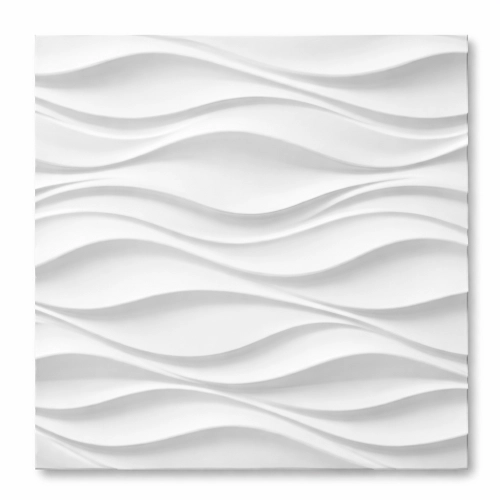
PU (Polyurethane) Stream Pattern Wall Panels represent a convergence of material science, architectural design, and modern construction efficiency. Characterized by flowing, wave-like surface geometries, these panels are used in both interior and exterior wall systems to achieve visual dynamism while meeting demanding technical requirements.
1. Material Composition and Chemistry
PU stream pattern wall panels are typically manufactured from rigid or semi-rigid polyurethane foam. The core material is formed through a controlled reaction between polyols and isocyanates, resulting in a closed-cell polymer structure.
Key Material Properties
- Density Control: Panels are engineered within a specific density range (commonly 300–800 kg/m³) to balance strength and weight.
- Closed-Cell Structure: Enhances moisture resistance, thermal insulation, and dimensional stability.
- Additives: UV stabilizers, flame retardants, and pigments are integrated during formulation to improve performance and longevity.
Compared to traditional materials such as gypsum or cement-based panels, PU offers higher strength-to-weight ratios and superior resistance to environmental stressors.
2. Stream Pattern Geometry and Structural Behavior
The defining stream or wave pattern is not merely decorative—it has structural implications.
Geometric Advantages
- Load Distribution: Curved surfaces distribute localized stresses more evenly than flat planes.
- Impact Resistance: The undulating profile can absorb and dissipate minor impacts more effectively.
- Visual Depth: Shadows and highlights generated by the stream pattern enhance perceived dimensionality without increasing panel thickness.
Advanced CAD and CNC mold design are used to optimize these patterns for both aesthetics and manufacturability.
3. Manufacturing Process
PU stream pattern wall panels are typically produced using high-pressure or low-pressure injection molding systems.
Process Stages
- Mold Preparation: Precision aluminum or steel molds define the stream pattern geometry.
- Injection and Foaming: Liquid PU components are injected and expand within the mold cavity.
- Curing: Controlled temperature and time ensure complete polymerization.
- Surface Finishing: Panels may receive coatings, laminations, or texturing to replicate stone, concrete, or metallic finishes.
Quality control focuses on dimensional accuracy, surface consistency, and internal cell uniformity.
4. Thermal and Acoustic Performance
One of the major technical advantages of PU stream pattern wall panels lies in their insulation properties.
Thermal Characteristics
- Low Thermal Conductivity: Typically around 0.020–0.025 W/m·K.
- Energy Efficiency: Reduces heat transfer, supporting building energy performance targets.
Acoustic Behavior
- Sound Diffusion: The stream pattern helps scatter sound waves, reducing echo and reverberation.
- Noise Reduction: When combined with backing layers or cavities, panels contribute to improved acoustic comfort.
These characteristics make the panels suitable for commercial spaces, hospitality environments, and residential interiors.
5. Fire Performance and Safety Considerations
Fire behavior is a critical technical concern for PU-based products.
Fire Mitigation Strategies
- Flame Retardant Formulations: Incorporation of halogen-free or intumescent additives.
- Surface Coatings: Fire-resistant coatings can improve reaction-to-fire classifications.
- Compliance: Panels are often tested to standards such as ASTM E84, EN 13501, or equivalent regional codes.
Proper specification and certification are essential to ensure compliance with local building regulations.
6. Installation Systems and Substrate Compatibility
PU stream pattern wall panels are designed for efficient installation across various substrates.
Common Fixing Methods
- Adhesive Bonding: High-strength PU or MS polymer adhesives for interior applications.
- Mechanical Fixing: Screws, anchors, or concealed rails for exterior or high-load areas.
- Modular Interlocking: Tongue-and-groove or hidden joint systems improve alignment and aesthetics.
Panels are compatible with concrete, drywall, metal framing, plywood, and composite backing systems.
7. Environmental Resistance and Durability
Long-term performance is a key technical differentiator.
Resistance Properties
- Moisture and Mold: Closed-cell PU resists water absorption and microbial growth.
- UV Stability: UV-resistant coatings prevent yellowing and surface degradation.
- Chemical Resistance: Suitable for environments exposed to mild acids, alkalis, and cleaning agents.
With proper maintenance, service life can exceed 15–20 years in interior applications and 10–15 years in exterior settings.
8. Sustainability and Environmental Impact
While PU is a synthetic polymer, modern manufacturing emphasizes sustainability.
Sustainability Measures
- Material Efficiency: Lightweight panels reduce transportation emissions.
- Longevity: Long service life lowers replacement frequency.
- Recyclability: Some manufacturers incorporate recycled polyols or design panels for partial recyclability.
Environmental product declarations (EPDs) are increasingly used to quantify lifecycle impact.
9. Application Scenarios
PU stream pattern wall panels are widely used in:
- Feature walls in commercial lobbies
- Hospitality and retail interiors
- Residential accent walls
- Exterior façades (with appropriate coatings)
- Exhibition and stage design
Their combination of technical performance and sculptural aesthetics enables flexible architectural expression.
PU Stream Pattern Wall Panels are more than decorative elements—they are engineered building components that integrate material science, structural geometry, and performance-driven design. By addressing thermal insulation, acoustic behavior, fire safety, durability, and installation efficiency, these panels offer a technically robust solution for modern architectural applications. When properly specified and installed, they provide long-term value, design flexibility, and reliable performance across a wide range of environments.