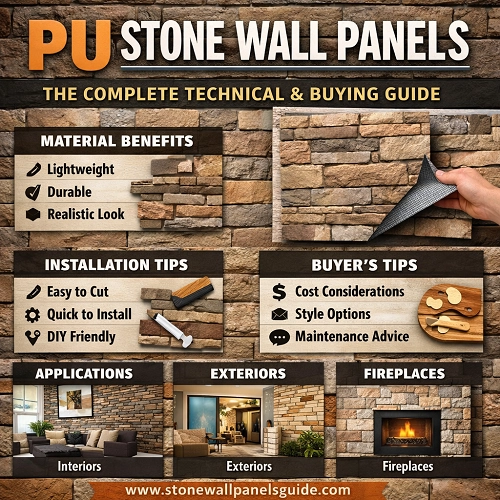
PU Stone Wall Panels: The Complete Technical & Buying Guide
Mar 26, 2026
What Is a PU Stone Wall Panel?
A PU Stone Wall Panel (polyurethane stone panel) is a lightweight, moulded wall-cladding material engineered to replicate the visual texture, dimensional depth, and colour variation of natural stone — without the structural weight, installation complexity, or quarrying cost associated with real masonry.
The panels are manufactured from high-density rigid polyurethane foam, a closed-cell thermoset polymer prized for its excellent strength-to-weight ratio, thermal insulation value, and chemical inertness. The outer surface receives a UV-stable, hand-tinted coating that faithfully replicates stone types such as sandstone, slate, granite, limestone, fieldstone, and stacked ledger.
Key insight: PU Stone is 30–70% lighter than natural stone, enabling installation on partition walls and ceilings that could never support real masonry — and dramatically reducing labour time on large commercial projects.
How PU Stone Is Manufactured
Understanding the production process helps specifiers appreciate why PU Stone achieves such high aesthetic fidelity and consistent quality at scale.
Mould Creation
Master moulds are created directly from selected real-stone samples using high-precision silicone or fibreglass tooling. Every grain, shadow, and surface irregularity of the original rock face is captured at 1:1 scale, ensuring that finished panels carry the same tactile realism as the natural source material.
Foam Injection & Curing
A two-component polyurethane system — polyol and isocyanate — is mixed under controlled conditions and injected into the heated mould. The exothermic reaction causes the mixture to expand and fill every cavity, forming a dense, closed-cell core with a hard outer skin. Cure time, mould temperature, and component ratio are tightly managed to guarantee consistent panel density (typically 30–80 kg/m³) across every production batch.
Surface Finishing
De-moulded panels pass through a multi-stage finishing line where technicians apply base coats and accent pigments by hand using a layering technique that reproduces the natural colour variation found in real stone. A final UV-resistant protective coat is applied to prevent surface degradation from sunlight exposure.
Quality Control & Certification
Each batch undergoes dimensional inspection, surface-adhesion testing, and fire-rating verification. Bingochic panels are manufactured to ISO quality standards and are available in Class B1 flame-retardant grades, complying with relevant international building codes.
Key Advantages Over Natural Stone
Ultra-Lightweight
Typically 1–3 kg per panel — about 1/10 the weight of equivalent natural stone.
Authentic Aesthetics
Moulds taken directly from real stone; hand-painted finishes for natural colour depth.
Class B1 flame-retardant grade meets international building code requirements.
Sound Insulation
PU foam core absorbs airborne sound, improving acoustic comfort in any room.
Eco-Conscious
No quarrying required; manufactured using recyclable materials and sustainable processes.
Product Series Overview
Bingochic offers an extensive portfolio of PU Stone Wall Panel series (A through L), each targeting a different aesthetic character and spatial application. The table below provides a quick orientation.
Each series ships in a curated palette of natural-stone colour tones. Custom colourways and private-label finishing are available for large-volume orders — please contact the Bingochic team for details.
Step-by-Step Installation Guide
One of the most compelling commercial advantages of PU Stone Wall Panels is their accessibility: no specialist stone-cutting tools, no heavy mortar, and no structural reinforcement are needed for typical interior applications.
Tools & Materials Required
Tape measure and chalk line / spirit level
Sharp utility knife or fine-tooth handsaw (for trim cuts)
High-strength construction adhesive (polyurethane or MS polymer type)
Stainless-steel screws + wall plugs (for exterior or high-load installations)
Colour-matched sealant / caulk for edge finishing
Damp cloth and mild detergent for surface preparation
Installation Steps
1
Surface PreparationEnsure the substrate is clean, structurally sound, dry, and reasonably flat (max 3 mm deviation per 2 m). Remove dust, grease, or loose paint.
2
Layout PlanningDry-lay panels on the floor first to arrange the pattern and avoid repeating textures side by side. Mark a level reference line on the wall to start the first row.
3
Apply AdhesiveApply construction adhesive in zigzag beads on the back of the panel, covering at least 60% of the surface area. For exterior use, apply adhesive to both the panel back and the wall surface.
4
Fix the PanelPress the panel firmly against the wall and hold for 30–60 seconds. For heavy exterior panels or seismic zones, supplement with stainless-steel screws at interlocking edges.
5
Align & InterlockButt subsequent panels tight to the preceding row using the interlocking edge system. Check level after every third panel; adjust before adhesive sets.
6
Trim CutsScore and snap with a utility knife for straight cuts; use a handsaw or jigsaw for curves and cut-outs around outlets and pipes.
7
Seal & FinishFill perimeter gaps with colour-matched sealant. Wipe away adhesive residue with a damp cloth before it cures. Allow 24 hours before the surface is exposed to heavy moisture or impact.
Pro tip: When installing around electrical boxes, cut the opening slightly undersized. PU foam shaves cleanly with a sharp blade, allowing precise fitting without gaps.
Industry Applications & Room Solutions
The versatility of PU Stone Wall Panels makes them suitable across virtually every building type and room. Below is an overview of Bingochic's recommended design solutions.
Table 4 — PU Stone Wall Panel Application Guide by Space
One of the strongest long-term arguments for PU Stone Wall Panels is their minimal maintenance requirement — a stark contrast to natural stone, which demands periodic professional sealing, crack repair, and re-grouting.
Routine cleaning: Wipe with a soft, damp cloth and mild soapy water. No specialist stone cleaners required.
Stubborn stains: Use a non-abrasive sponge with a gentle kitchen degreaser. Rinse thoroughly and allow to air-dry.
Chemicals to avoid: Bleach, acetone, and abrasive scouring pads can damage the UV-stable top coat.
No sealing required: The factory-applied protective coating eliminates the need for periodic resealing.
Minor surface scuffs: Light touch-up with colour-matched acrylic paint is effective; contact Bingochic for touch-up kit availability.
Inspection interval: Visually inspect adhesive bonds at perimeter edges annually, especially in exterior covered applications subject to thermal cycling.
Lifespan: Under normal residential conditions and with basic care, Bingochic PU Stone Wall Panels are designed for long-term performance without repainting or structural intervention.
Frequently Asked Questions
How does PU Stone differ from real stone?
PU Stone is a moulded synthetic panel made from high-density polyurethane foam. It replicates the look and feel of natural stone at roughly 30–70% less weight. Unlike real stone, it requires no mortar, no structural reinforcement, zero water absorption, and minimal maintenance. See the full comparison in Table 2 above.
Can PU Stone Wall Panels be used outdoors?
Most Bingochic PU Stone panels are suitable for covered outdoor areas such as porticos, garden feature walls, and patios with overhead protection. Prolonged direct exposure to rain, standing water, or extreme UV without any overhead cover is not recommended for standard grades. Ask about outdoor-grade variants with enhanced weather coatings for exposed façade applications.
Are PU Stone panels fire-safe?
Yes. Bingochic offers Class B1 flame-retardant grades that meet European and equivalent international building-code requirements. Always specify the fire-rated grade for commercial, hospitality, and public-sector projects where fire safety compliance is mandatory.
Can I cut the panels on-site?
Absolutely. PU foam cuts cleanly with a sharp utility knife (score-and-snap for straight lines) or a fine-tooth handsaw / jigsaw for more complex profiles. No specialist stone-cutting equipment or diamond blades are needed, which significantly reduces tool costs on site.
What is the minimum order quantity for wholesale buyers?
Minimum order quantities vary by series and destination. Bingochic supplies retailers, distributors, and large-project contractors globally. Contact the sales team for a volume quotation and lead-time confirmation.