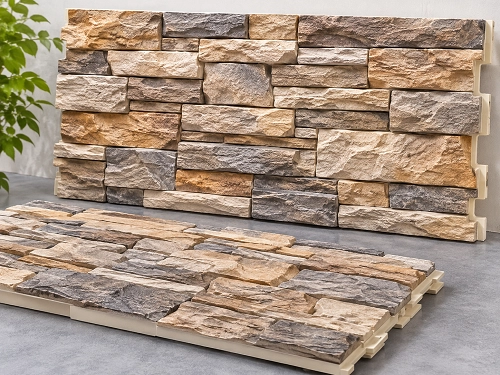
Natural stone has long been valued for its distinctive textures, architectural character, and durability. However, its considerable weight, transportation costs, installation requirements, and structural limitations can make it difficult to use in certain construction and renovation projects. Polyurethane (PU) faux stone offers an alternative that recreates the appearance of natural stone while reducing material weight and simplifying installation.
Unlike traditional stone veneer, PU faux stone is manufactured using polyurethane-based materials molded into stone-like patterns. It can reproduce the irregular surfaces, layered textures, and color variations of materials such as slate, limestone, sandstone, and fieldstone.
But choosing PU faux stone involves more than comparing its appearance with natural stone. Buyers, contractors, architects, and property developers need to understand how it performs under different environmental conditions, what determines its quality, and where its limitations become important.
Polyurethane faux stone is a decorative wall cladding material designed to imitate the appearance of natural stone. It is typically produced by molding polyurethane-based material into panels or individual stone profiles, with surface details and finishes created to resemble real masonry.
The material's defining characteristic is its combination of a stone-like appearance and a relatively lightweight polyurethane structure.
Depending on the manufacturer and product design, PU faux stone may feature:
Irregular stone textures and realistic surface contours.
Multiple colors and layered finishes.
Simulated mortar joints and natural stone arrangements.
Interlocking edges or overlapping panel designs.
Different thicknesses and dimensional profiles.
PU faux stone is commonly used for interior accent walls, exterior decorative facades, commercial interiors, hospitality spaces, and residential renovations.
An important distinction: PU faux stone is not natural stone, and it should not automatically be treated as equivalent to cement-based manufactured stone veneer. Their material compositions, fire performance, weather resistance, and installation requirements can differ significantly.
Understanding the manufacturing process helps explain why some PU faux stone products look more realistic and perform better than others.
Although production methods vary, the process generally involves several stages.
Manufacturers first create molds based on natural stone patterns or custom-designed architectural textures.
The quality of the mold directly influences the finished product. Detailed molds can reproduce:
Natural cracks and surface irregularities.
Layered rock formations.
Rough, weathered edges.
Subtle differences in stone depth and shape.
High-quality molds help avoid the repetitive, artificial appearance that can occur when identical patterns are installed across a large wall.
Polyurethane is formed through a chemical reaction between polyols and isocyanates. Depending on the formulation, manufacturers can adjust characteristics such as density, flexibility, rigidity, and mechanical strength.
For faux stone applications, the formulation must provide sufficient dimensional stability while allowing detailed surface reproduction.
Material formulation is particularly important because two products with similar appearances may have very different physical properties.
The prepared polyurethane material is introduced into the molds and allowed to cure.
During this stage, the material develops its intended shape, surface texture, and structural characteristics.
Manufacturers must control the formulation and curing conditions to achieve consistent dimensions and reduce defects such as incomplete molding, surface imperfections, and inconsistent density.
After curing, panels undergo finishing processes that may include trimming, coating, painting, or applying decorative color treatments.
The final inspection should evaluate:
Panel dimensions and thickness consistency.
Surface texture and color uniformity.
Edge quality and connection details.
Visible defects or deformation.
Compliance with applicable performance requirements.
For buyers sourcing PU faux stone from manufacturers, quality control should cover both visual appearance and measurable product performance.
The main advantage of PU faux stone is not simply that it looks like natural stone. Its practical value comes from how its material properties affect transportation, installation, and long-term use.
One of the most important characteristics of PU faux stone is its relatively low weight compared with conventional stone products.
Natural stone and cement-based stone veneer can require additional handling and structural considerations because of their weight. PU panels are generally easier to transport, lift, position, and cut.
This can be particularly beneficial for:
Interior renovation projects.
Upper-floor decorative walls.
Retail and hospitality fit-outs.
Projects where reducing installation labor is important.
Existing buildings with limited wall-load capacity.
However, lightweight construction does not eliminate the need for proper substrate preparation and mechanical fastening where required.
The visual quality of PU faux stone depends on mold precision, surface detailing, color treatment, and panel arrangement.
A convincing product should reproduce more than a basic stone color. It should also capture the depth, shadow, irregular edges, and natural variations associated with real stone.
For larger installations, buyers should pay particular attention to pattern repetition. Excessive repetition can make a finished wall look artificial, even when individual panels are well manufactured.
A useful purchasing practice is to request multiple sample panels and arrange them together before approving a large production order.
Polyurethane itself generally has relatively low water absorption compared with many porous mineral-based materials. This makes PU faux stone potentially suitable for decorative applications where occasional moisture exposure is expected.
However, the moisture performance of a finished wall depends on more than the panel material.
Important factors include:
Surface coatings and protective finishes.
Panel joints and connection details.
Installation adhesives and sealants.
Substrate moisture conditions.
Water drainage and ventilation behind the cladding.
For exterior applications, buyers should request documented water-resistance and weathering test results for the complete product system rather than relying on general claims about polyurethane.
Polyurethane is widely used in insulation applications because certain PU foam formulations have low thermal conductivity.
Nevertheless, not every PU faux stone panel should be considered an insulation product.
Decorative panels may have different formulations, densities, thicknesses, and internal structures. Their thermal performance cannot be determined simply from the fact that they contain polyurethane.
If thermal insulation is an important project requirement, request the product's tested thermal conductivity (λ-value) and, where applicable, the calculated R-value for the installed assembly.
PU faux stone can offer practical resistance to everyday handling and minor impacts, depending on its density, formulation, panel thickness, and surface finish.
However, it is not indestructible.
Potential issues include:
Dents from concentrated impacts.
Scratches caused by sharp objects.
Surface coating damage.
Deformation under excessive heat.
Aging or discoloration under prolonged UV exposure.
For commercial environments, corridors, entrances, and other high-traffic areas, it is important to evaluate the actual impact resistance of the selected product.
Fire performance deserves particular attention when selecting polyurethane-based decorative materials.
Polyurethane is an organic polymer, so its fire behavior differs from that of natural stone, concrete, and other inorganic materials.
Fire performance depends on the formulation, additives, panel construction, thickness, and complete wall assembly.
Buyers should request relevant fire-test documentation, such as ASTM E84 or EN 13501-1 classifications, where applicable to the project and market.
A classification should never be assumed based solely on the material name. The test report must correspond to the actual product and intended installation configuration.
Selecting the right wall cladding material requires balancing appearance, weight, installation requirements, maintenance, and project conditions.
The following comparison highlights the practical differences.
|
Comparison factor |
PU Faux Stone |
Natural Stone |
Cement-Based Stone Veneer |
|---|---|---|---|
|
Material composition |
Polyurethane-based |
Natural mineral stone |
Cement and mineral aggregates |
|
Weight |
Generally lightweight |
Generally heavy |
Moderate to heavy |
|
Appearance |
Molded stone-like texture |
Authentic natural variations |
Manufactured stone appearance |
|
Installation |
Usually relatively simple |
Often labor-intensive |
Requires appropriate masonry installation |
|
Cutting and handling |
Generally easier |
Requires specialized tools |
Requires masonry cutting tools |
|
Moisture behavior |
Depends on product and joints |
Varies by stone type |
Depends on porosity and sealing |
|
Fire behavior |
Requires product-specific testing |
Generally noncombustible |
Generally noncombustible, subject to composition |
|
Maintenance |
Usually relatively simple |
Depends on stone type and finish |
May require cleaning and sealing |
There is no universally superior option.
Natural stone remains a strong choice for projects that prioritize authentic geological materials, long service life, and traditional masonry characteristics.
Cement-based stone veneer may be preferable where a mineral-based decorative finish and greater similarity to traditional masonry construction are required.
PU faux stone is particularly attractive when low weight, installation convenience, and decorative flexibility are major considerations.
PU faux stone can be used in a variety of architectural and decorative environments.
PU faux stone can be used to create stone-like architectural facades without the weight associated with conventional masonry.
Common applications include:
Residential exterior accent walls.
Decorative entrance surrounds.
Garden walls and outdoor structures.
Commercial building feature sections.
For exterior projects, confirm UV resistance, temperature tolerance, moisture performance, wind-load requirements, and suitability for the local building code.
Interior feature walls are among the practical applications of lightweight faux stone.
They can add visual depth and a natural material appearance to:
Living room backgrounds.
Reception areas.
Hotel lobbies.
Restaurant interiors.
Retail display walls.
Because PU panels are relatively lightweight, they can be easier to handle during renovation projects where extensive structural modifications are undesirable.
PU faux stone can create a decorative stone-like appearance around fireplace installations.
However, this application requires careful consideration of heat exposure.
The material must not be installed in areas exposed to temperatures beyond its tested service limits. Required clearances and noncombustible materials around fireplaces must follow the appliance manufacturer's instructions and applicable building regulations.
A decorative appearance alone does not establish that a panel is suitable for fireplace use.
Hotels, restaurants, cafes, showrooms, and retail stores often use stone-effect wall finishes to establish a particular architectural style.
PU faux stone can help create a consistent decorative appearance across multiple locations while simplifying material handling.
For commercial projects, additional attention should be given to fire regulations, cleaning requirements, impact resistance, and long-term color stability.
Although installation methods vary by product, PU faux stone panels are generally designed to be easier to install than traditional stone cladding.
A typical installation process involves the following steps.
Inspect and prepare the wall
Check that the substrate is stable, clean, dry, and suitable for the selected installation system.
Remove loose paint, dust, grease, and other contaminants that could interfere with adhesion.
Measure and plan the layout
Measure the wall and determine the panel arrangement before installation.
Pay attention to corners, openings, edges, and transitions. Planning the layout helps reduce unnecessary cutting and visible pattern repetition.
Cut panels to the required dimensions
Use appropriate cutting tools according to the manufacturer's instructions.
Make sure edges are clean and accurate, especially around corners and connection points.
Apply the recommended adhesive or fastening system
Use adhesives and mechanical fasteners specifically approved for the panel material and substrate.
Some systems use adhesive bonding, while others require additional mechanical fastening. Exterior applications may have more demanding requirements because of wind exposure and temperature changes.
Position and connect the panels
Install panels according to the manufacturer's recommended sequence.
Check alignment, joint consistency, and surface continuity throughout the process.
Finish joints and inspect the completed wall
Use compatible sealants, coatings, or finishing materials where required.
Inspect the finished surface for gaps, uneven alignment, visible fasteners, and color differences.
One important point: installation instructions should come from the actual product manufacturer. A method suitable for an interior decorative panel should not automatically be applied to an exterior facade system.
For distributors, contractors, importers, and project buyers, evaluating PU faux stone requires more than reviewing product photographs.
The following factors can help reduce purchasing risks.
Ask the manufacturer about the polyurethane formulation, density, thickness, and production tolerances.
Consistent material properties are important for maintaining uniform appearance and performance across large orders.
Request physical samples rather than relying exclusively on catalog images.
Evaluate:
Texture depth and definition.
Natural-looking color variation.
Edge detailing.
Surface coating quality.
Repeated patterns across multiple panels.
A reliable supplier should be able to provide relevant technical information, including:
|
Technical parameter |
Why it matters |
|---|---|
|
Panel dimensions |
Determines installation layout |
|
Panel thickness |
Affects appearance and dimensional stability |
|
Density |
Helps evaluate material consistency |
|
Weight per panel or square meter |
Important for handling and wall loading |
|
Water absorption or moisture test |
Relevant to environmental exposure |
|
UV and weathering performance |
Important for exterior applications |
|
Fire classification |
Required for many building projects |
|
Temperature resistance |
Determines suitable operating environments |
|
Installation instructions |
Helps ensure correct application |
Not every product needs every test. The appropriate documentation depends on the intended application and destination market.
Ask whether the manufacturer has conducted accelerated aging, temperature cycling, UV exposure, and other relevant durability tests.
These tests help evaluate how a product may respond to environmental stresses.
However, accelerated test results should not be interpreted as a guaranteed number of years of real-world service life.
For bulk purchasing or OEM projects, the supplier's manufacturing capabilities can be just as important as the product itself.
Consider asking about:
Mold development and customization.
Available colors and stone patterns.
Production capacity.
Quality inspection procedures.
Sample development and approval.
Packaging and transportation protection.
Export experience and technical support.
A manufacturer with established production and quality-control procedures is better positioned to maintain consistency across repeat orders.
Even a well-designed product can underperform when the wrong material is selected or installation requirements are overlooked.
|
Potential problem |
Possible cause |
Practical solution |
|---|---|---|
|
Color fading |
UV exposure or unstable coatings |
Select products with documented UV performance |
|
Panel deformation |
Excessive heat or poor dimensional stability |
Check temperature limits and material specifications |
|
Poor adhesion |
Unsuitable adhesive or contaminated substrate |
Follow approved installation instructions |
|
Visible panel repetition |
Limited mold patterns |
Use multiple patterns and plan panel placement |
|
Surface damage |
Concentrated impact or abrasion |
Select suitable products for the intended traffic level |
|
Moisture penetration |
Poor joints or incorrect installation |
Use compatible sealants and proper detailing |
The key lesson is that product quality and installation quality must be evaluated together.
A panel with excellent surface detailing may still fail in an exterior application if its fastening system, protective finish, or environmental resistance is inadequate.
Some PU faux stone products are designed for exterior applications. However, outdoor suitability depends on UV resistance, moisture performance, temperature tolerance, coatings, and installation methods. Always verify the manufacturer's technical documentation before using the product on an exterior wall.
Polyurethane generally has relatively low water absorption, but this does not mean every PU faux stone wall system is completely waterproof. Panel joints, fasteners, coatings, and the underlying wall assembly all influence water resistance.
No. Polyurethane is an organic polymer and should not be described as inherently fireproof. Fire performance depends on the specific formulation and tested product assembly. Always request relevant fire-test reports.
In many cases, yes. However, the existing wall must be structurally sound and compatible with the manufacturer's recommended adhesive or fastening system. Additional preparation or mechanical support may be necessary.
Maintenance is generally straightforward. Routine cleaning with suitable non-abrasive methods is often sufficient for decorative applications. Exterior products may require periodic inspection of joints, coatings, and exposed edges.
It depends on project requirements. PU faux stone is generally more convenient when lightweight construction and easier installation are priorities. Natural stone is more appropriate when authentic mineral composition, traditional masonry characteristics, and natural stone variation are essential.
Many manufacturers offer different stone textures, colors, dimensions, and surface finishes. Customization may also include mold development for specific architectural designs. Availability depends on the manufacturer's production capabilities and minimum order requirements.