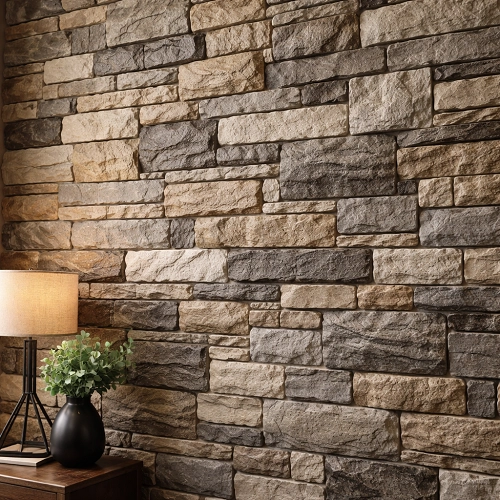
In modern architectural and interior design, Realistic 3D PU Stone Wall Tile has emerged as a high-performance decorative cladding solution that combines aesthetic authenticity with advanced material engineering. Designed to replicate the texture and depth of natural stone, these panels provide a lightweight, durable, and cost-efficient alternative to traditional masonry systems.
PU stone wall tiles are primarily manufactured from polyurethane (PU), a versatile polymer formed by reacting:
The resulting material is a rigid closed-cell polyurethane foam composite, engineered to deliver structural integrity while maintaining low density.
The internal microstructure consists of sealed air pockets that:
Unlike open-cell foams, closed-cell PU minimizes water absorption, making it suitable for exterior cladding.
The realism of 3D PU stone panels depends on advanced mold replication technology.
Manufacturers typically use:
The molding process captures:
After demolding, panels receive:
This multi-layer system enhances:
Typical density ranges:
This makes PU stone panels up to 80% lighter than natural stone, significantly reducing structural load requirements.
While not load-bearing, rigid PU panels offer sufficient compressive resistance for wall applications, generally:
The polymer matrix absorbs minor impacts better than brittle stone, reducing cracking risks during transport and installation.
Properly formulated PU tiles exhibit:
Fire classification depends on additives and local building codes.
Typical configurations may achieve:
Fire-retardant PU panels include:
It is essential to verify certification for specific regional compliance.
One of the major technical advantages of PU stone panels is insulation performance.
Rigid PU foam typically exhibits:
This provides excellent insulation compared to:
When installed on exterior walls, PU stone tiles can:
Due to its cellular structure, PU material provides moderate sound absorption.
Applications include:
While not a primary acoustic solution, it enhances sound dampening compared to hard stone surfaces.
Common installation methods include:
High-strength construction adhesives are often used in combination with mechanical fastening for added security.
Many Realistic 3D PU Stone Wall Tiles feature:
This ensures:
Closed-cell polyurethane absorbs less than 2% water by volume, providing:
Advanced UV coatings prevent:
Exterior-grade panels can withstand:
| Property | PU Stone Tile | Natural Stone |
| Weight | Very light | Very heavy |
| Installation Speed | Fast | Slow |
| Structural Load | Minimal | High |
| Cost | Lower | Higher |
| Maintenance | Low | Moderate |
| Insulation | Excellent | Poor |
PU panels eliminate:
Modern manufacturers aim to reduce environmental impact through:
Though polyurethane is petroleum-based, its lightweight nature reduces:
Realistic 3D PU Stone Wall Tiles are widely used in:
Lightweight construction makes PU panels ideal for:
Maintenance requirements are minimal:
Expected lifespan:
High-quality production includes:
Manufacturers following ISO standards ensure uniformity and compliance with global building regulations.
Emerging developments include:
These innovations aim to further improve durability, sustainability, and performance.
Realistic 3D PU Stone Wall Tile represents a sophisticated fusion of polymer chemistry, surface engineering, and architectural design. Its lightweight composition, strong thermal performance, cost efficiency, and installation versatility make it a compelling alternative to traditional stone cladding systems.