PVC Decorative Panels: The Complete Technical Guide for Modern Interiors
Mar 11, 2026
What Is a PVC Decorative Panel?
A PVC Decorative Panel is a surface-finishing product manufactured primarily from polyvinyl chloride (PVC) resin — one of the world's most versatile synthetic polymers. Engineered to clad walls, ceilings, and partitions, these panels combine structural protection with aesthetic versatility, replacing traditional materials such as ceramic tile, gypsum board, and painted plaster in a growing share of residential and commercial construction projects.
Unlike raw PVC sheeting, decorative panels are formulated with a precise blend of stabilizers, plasticizers, pigments, and surface-coating layers that govern their appearance, mechanical performance, and fire behaviour. The result is a composite building element that can authentically replicate marble, natural timber, brushed metal, fabric weaves, or geometric relief patterns — at a fraction of the weight and cost of the originals.
According to industry data compiled by Haining Bingochic Decoration Material Co., Ltd., demand for PVC wall panels has expanded steadily across more than 70 export markets, driven by growth in modular construction, hospitality fitouts, and rapid-renovation residential projects worldwide.
Cross-sectional layer architecture of a standard hollow-core PVC decorative wall panel.
Polymer Chemistry & Composition
Polyvinyl chloride (PVC) is produced by the polymerization of vinyl chloride monomer (VCM). The polymer chain's high chlorine content — approximately 57% by weight — is the primary source of the material's inherent flame-retardancy, chemical resistance, and dimensional stability.
For decorative building panels, raw PVC compound is compounded with several additive families:
Thermal Stabilizers
During extrusion at temperatures between 160 °C and 200 °C, PVC chains are susceptible to thermal degradation and dehydrochlorination. Heat stabilizers — historically lead-based compounds, now predominantly calcium-zinc (Ca/Zn) systems or organic-based stabilizers in markets requiring RoHS/REACH compliance — arrest this degradation and preserve colour integrity over the product's service life.
Plasticizers
Rigid PVC panels for wall cladding use little or no plasticizer (PVC-U formulations), which maximises hardness, creep resistance, and long-term dimensional stability. Flexible decorative films, where applied, may incorporate DINP or DOTP plasticizers that are EU-approved as phthalate-free alternatives.
Impact Modifiers
ACR (acrylic processing aids) and CPE (chlorinated polyethylene) modifiers improve the notched impact strength of rigid panels — an important specification for panels used in high-traffic corridors, retail environments, and logistics facilities.
Surface Coating Technology
High-gloss and matte finishes are applied via UV-curable lacquers or PET/PETG lamination films. UV-cured coatings cure in milliseconds under mercury-arc or LED UV lamps, producing a cross-linked hard surface with pencil hardness of 2H–4H, excellent scratch resistance, and near-zero VOC emission after curing.
Industry Note: Bingochic's PVC Panel line uses Ca/Zn stabilisation systems across all product series, meeting REACH SVHC restrictions and enabling safe use in residential spaces including nurseries and kitchens.
~0%
Water Absorption Rate
57%
Chlorine Content in PVC (natural FR)
−20°C to 60°C
Service Temperature Range
10–20yr
Expected Service Life (residential)
70+
Export Markets (Bingochic)
Panel Types & Product Series
The PVC panel product family at Bingochic is structured around panel width — the most consequential dimension for both aesthetic layout and installation speed — combined with surface treatment category.
200mm Series
The 200mm PVC Panel Series is the industry's narrowest mainstream width, offering a pronounced horizontal or vertical plank aesthetic reminiscent of shiplap or tongue-and-groove timber cladding. Available in thicknesses ranging from 5 mm to 8.5 mm, with groove profiles including flat, V-groove, and U-groove options, this series suits bathrooms, hallway dados, and feature walls where a rhythmic plank pattern is desired. SKUs include CTM200-1 through CTM200-10.
250mm Series
The 250mm Panel Series represents the market's volume product — balancing installation speed, seam frequency, and procurement cost. It covers the widest range of surface finishes, from high-gloss marble effect to embossed woodgrain, and is the preferred specification for hotel corridors, residential living rooms, and commercial fitouts that prioritise visual consistency over a pronounced plank effect.
300mm Series
At 300mm, panels span larger wall areas per strip, reducing joint lines by approximately 33% versus 200mm panels — an important consideration for large contemporary interiors where seamlessness is valued. Thicker options (9–10 mm) in this series carry enhanced rigidity suitable for mechanical fixing without batten framing.
595 / 600 / 603mm Series
The wide-format series (595, 600, or 603mm nominal widths) is engineered primarily for suspended ceiling systems and large-scale wall cladding in commercial spaces. The slight width variations accommodate different modular ceiling grid systems used internationally (metric and customary module grids). These panels are typically lighter per strip to facilitate overhead installation.
3D PVC Wall Panel
The 3D PVC Wall Panel range introduces sculptural relief surfaces produced by deep thermoforming during extrusion. Geometric, wave, diamond, and botanical motifs create tactile surfaces that capture light dynamically. Used extensively in hospitality lobbies, feature walls, exhibition stands, and residential accent walls.
Technical Specifications at a Glance
The following table consolidates key performance parameters drawn from Bingochic's PVC Panel product documentation. Individual product SKUs may vary; always consult current technical data sheets before specification.
Installation Methods — Step by Step
PVC decorative panels can be fixed by three primary methods, each suited to specific substrate conditions and project requirements. Selecting the correct method is critical to preventing panel delamination, buckling from thermal expansion, and moisture ingress at joints.
Method A — Direct Adhesive Bond
Surface Preparation
Ensure the substrate wall is dry (moisture content below 5%), structurally sound, and free of loose paint, dust, grease, or efflorescence. Sand high spots and fill voids with filler compound; allow 24 h cure.
Primer Application
Apply a PVC-compatible bonding primer to porous substrates (concrete, plaster). Allow to tack dry per manufacturer instructions (typically 20–40 min).
Adhesive Application
Apply panel adhesive in serpentine beads on the panel back, or as spot dabs at 150 mm centres. MS-polymer or solvent-free contact adhesives are recommended to avoid PVC swelling.
Panel Placement
Press the panel firmly from the centre outward, ensuring full contact. Use a rubber roller or squeegee block. Maintain 5 mm expansion clearance at all perimeters and around penetrations.
Finishing Trims
Snap or glue PVC angle trim, J-trim, or cornice profiles to finish edges, corners, and ceiling/floor junctions. These PVC decorative lines are designed to coordinate with each panel series.
Method B — Batten Frame System
Where walls are uneven, subject to moisture behind the cladding layer, or when a ventilated cavity is desired (common in bathrooms and cold-storage rooms), PVC or treated-timber battens are fixed to the substrate at 400–600 mm centres. Panels are then clip- or nail-fixed to the battens, with no direct contact with the potentially damp substrate. This system also simplifies the integration of in-wall insulation blankets behind the cladding layer.
Method C — Tongue-and-Groove Floating Fix
The most commonly used method for ceiling installation and rapid wall renovation, tongue-and-groove interlocking requires only that the first and last panels be mechanically fixed; intermediate panels click together and are retained by the interlocking joint. This system accommodates the relatively high thermal expansion coefficient of PVC (60–80 × 10⁻⁶ /°C) by allowing each panel to slide slightly within its neighbour's groove as temperatures change.
Professional Installation Tip
Always store panels flat in the installation environment for 48 hours before fixing. This allows the panels to acclimatise to the room's ambient temperature and humidity, minimising post-installation dimensional movement — a critical step in heated or air-conditioned spaces where temperature swings routinely exceed 15 °C.
Applications by Room & Industry
Bingochic's Solutions pages organise PVC panel applications by room type, reflecting how interior designers and contractors actually specify materials. The following sections expand on the technical rationale behind each application context.
Near-zero water absorption and mould resistance make PVC panels the direct replacement for ceramic tile, at 40–60% less installation time. Choose UV-cured gloss finishes for easy wipe-clean maintenance.
Splashback zones, ceiling linings above cooking ranges, and dado cladding benefit from panels with chemical resistance to cooking fats, cleaning agents, and steam.
Feature walls and full-height cladding using marble-effect or woodgrain panels create high-design interiors at a fraction of natural material costs. 3D PVC panels add sculptural depth.
Antimicrobial-additive PVC panels meet the hygiene requirements of clinical corridors, patient rooms, and wet-utility spaces without the grout-line harbouring risk of ceramic tile.
Food & Cold Storage
Panels in meat processing and cold storage environments require certification to food-contact standards and performance down to −20 °C. Bingochic's engineering team can advise on appropriate SKU selection.
Food & Cold Storage
Panels in meat processing and cold storage environments require certification to food-contact standards and performance down to −20 °C. Bingochic's engineering team can advise on appropriate SKU selection.
"PVC wall panels have evolved from a utility product into a genuine design material — one that delivers both the moisture resilience demanded by building codes and the visual richness expected by today's design-conscious end users."
Section 07
Maintenance, Repair & Longevity
One of PVC's most compelling advantages over natural materials is the minimal maintenance burden. The non-porous surface prevents absorption of staining agents, and the chemical resistance of the PVC compound means that a wide range of commercial cleaning products can be safely used.
Routine Cleaning Protocol
For residential and hospitality environments, weekly cleaning with a soft microfibre cloth dampened with warm water and a pH-neutral detergent (concentration not exceeding 5%) is sufficient to maintain surface appearance. Rinse with clean water and dry — or allow to air-dry — promptly. For clinical environments, quaternary ammonium or dilute hypochlorite solutions may be used at recommended concentrations without risk to panel integrity.
Avoiding Surface Damage
Avoid abrasive scourers, wire wool, and concentrated organic solvents (acetone, MEK, toluene) on UV-coated surfaces, as these will dissolve or scratch the topcoat layer. The base PVC substrate itself is resistant to most solvents, but surface finish integrity depends on preserving the topcoat. For embossed or textured panels, a soft-bristle brush dislodges particulate trapped in relief features without scratching.
Individual Panel Replacement
A significant practical advantage of tongue-and-groove or clip-fixed systems is the ability to replace individual damaged panels without disturbing the surrounding installation. Remove the trim at the closest edge, slide out panels sequentially to the damaged unit, replace, and re-clip. This is impossible with ceramic tile (where replacement typically cracks adjacent tiles) and practically very difficult with painted plasterboard.
Expected Service Life
With correct installation and routine cleaning, residential PVC panels typically deliver 10–20 years of service before any aesthetic degradation becomes noticeable. Commercial installations — particularly in food processing, healthcare, and cold storage — may achieve 5–15 years in demanding environments before scheduled replacement as part of planned maintenance programmes.
Section 08
Standards & Certifications
Quality PVC decorative panels are tested and certified against internationally recognised standards. Buyers specifying panels for commercial, healthcare, or export projects should verify the following certifications with their supplier.
Standard / Certification
Scope
Relevance
EN 13501-1 (Euroclass)
Fire reaction classification for construction products
EU building codes; Class B mandatory in many commercial projects
ASTM E84 (Flame Spread)
Surface burning characteristics
North American commercial buildings
REACH SVHC (EU)
Restriction of substances of very high concern
Ensures Ca/Zn stabilisation; no restricted phthalates
Relevant for residential use; confirms low off-gassing
GB/T (China National Standard)
Various Chinese national test standards
Applicable to domestic China market sales
Buyer's Checklist: Always request the current test report (dated within 3 years) alongside the certification number. Fire performance in particular degrades if the compound formulation changes, so updated documentation is essential. Contact Bingochic's technical team for project-specific compliance documentation.
Sustainability Considerations
The sustainability profile of PVC is complex and subject to ongoing improvement within the industry. A balanced assessment requires examining material sourcing, in-use performance, end-of-life recyclability, and the comparative impact versus alternative materials.
Material Sourcing
PVC resin is derived from approximately 43% petrochemicals (ethylene) and 57% common salt (chlorine via the chlor-alkali process). The significant salt-derived fraction is a renewable inorganic mineral, making PVC's fossil-fuel dependency lower per kilogram than polyethylene or polypropylene. Bio-based PVC using bioethanol-derived ethylene is an emerging option for manufacturers seeking to reduce Scope 3 emissions.
In-Use Efficiency
PVC panels' long service life (10–20 years) and minimal maintenance — no repainting, no resealing, no grout replacement — translate to a lower lifetime environmental impact than apparently "greener" alternatives that require frequent maintenance interventions. Their light weight (vs. ceramic tile or stone) also reduces the structural load on buildings, potentially enabling lighter structural frameworks.
Recyclability & Circular Economy
PVC is technically 100% recyclable at end-of-life. Post-industrial and post-consumer PVC scrap is collected by VinylPlus-certified recyclers in Europe and processed into new construction products. Bingochic's manufacturing process recycles in-house production trim and off-cuts back into non-visible core layers — a closed-loop approach that reduces material waste at the factory level. Some SKUs incorporate recycled PVC content without compromising mechanical performance or surface finish quality.
Phasing Out Legacy Additives
The industry-wide transition from lead-based to Ca/Zn stabilisation systems — now essentially complete among reputable manufacturers — significantly improved the environmental and human health profile of PVC building products. Similarly, the move away from DEHP and other restricted phthalate plasticizers toward REACH-compliant alternatives has addressed the key toxicological concerns historically associated with PVC.
Section 10
PVC vs. Competing Wall Cladding Materials
Designers and specification writers frequently compare PVC decorative panels against ceramic tile, painted plasterboard, natural timber cladding, and composite alternatives. The following comparison addresses the most material performance criteria.
Criterion
PVC Panel
Ceramic Tile
Painted Plasterboard
Natural Timber
Water Resistance
Excellent (≈0%)
Good (grout is vulnerable)
Poor (requires sealing)
Poor (requires treatment)
Mould Resistance
Excellent
Moderate (grout lines)
Poor
Poor
Installation Speed
Very Fast
Slow (wet trades)
Moderate
Slow
Weight (kg/m²)
2–4 kg/m²
15–22 kg/m²
8–13 kg/m²
6–12 kg/m²
Repair / Replace
Individual panel
Difficult (cracks adjacent)
Patch & repaint
Difficult
Design Flexibility
Very High (50+ patterns)
High
Moderate
Moderate
Cost (relative)
Low–Medium
Medium–High
Low
High
Fire Performance
Class B (FR grade)
Non-combustible
Class C–D
Class C–E
Maintenance Effort
Minimal
Low–Moderate (grout)
Moderate (repainting)
High (oiling/sealing)
Design Trends 2024–2025
The aesthetic vocabulary of PVC decorative panels has expanded dramatically in the past decade, moving from commodity-grade plain white to sophisticated surface treatments that command premium specification. Key trends shaping product development include:
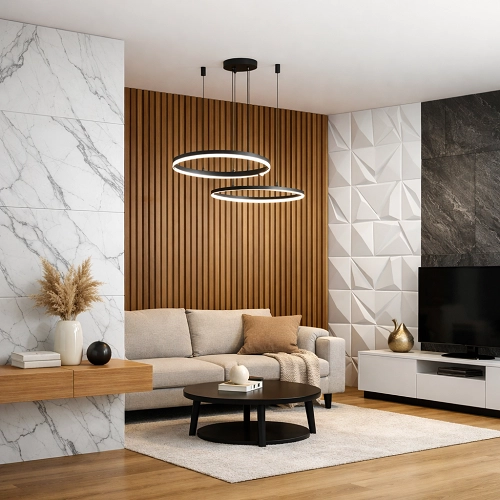
Leading surface aesthetic trends in PVC decorative panels for 2024–2025, from earthy travertine effects to minimalist high-gloss and 3D geometric reliefs.
Natural Stone & Mineral Aesthetics
Travertine, limewash, raw concrete, and warm terracotta effects — collectively influenced by the biophilic design movement — dominate residential specification. Advances in digital printing technology now allow photorealistic reproduction of stone veining patterns at resolutions up to 1440 dpi on PVC film, applied to panels at production-line speeds.
Japandi & Muted Woodgrain
The Japandi (Japanese-Scandinavian) design vocabulary — characterised by muted, warm-toned timber grains, restrained profiles, and an emphasis on craft-like materiality — is driving demand for fine-grain oak, ash, and elm woodgrain prints in natural brown, greige, and grey-brown tones. The 200mm and 250mm narrow-plank formats are particularly well-suited to this aesthetic.
3D Sculptural Surfaces
The 3D PVC wall panel category is one of the fastest-growing segments in the decorative panel market, driven by the hospitality sector's demand for Instagram-able lobby and restaurant environments. Geometric diamond, wave, and brick-bond relief patterns create dynamic shadow play under directional lighting — an effect impossible to replicate with flat-surface competitors.
Integrated Wall Systems
The Integrated Wall Panel category represents the next evolution — combining PVC panel cladding with coordinating skirting, cornice, dado rail, and trim profiles in a unified system that dramatically simplifies specification and site procurement. SPC and WPC integrated panel systems add rigidity and impact resistance for commercial applications.
About Bingochic — The Supplier Behind the Specification
Based in Haining City, Zhejiang Province, China — the heart of China's building materials manufacturing belt — Bingochic operates a fully integrated facility covering design, extrusion production, surface finishing, quality testing, and global logistics. The company's product portfolio spans PU Stone, PVC Panels, SPC Flooring, SPC/UV Boards, Integrated Wall Panels, Foaming Solid Board, and 3D PVC Wall Panels — enabling one-stop procurement for whole-room decoration projects.
For trade enquiries, product samples, or technical documentation, contact alice.yin@bingochic.com or visit the company's contact page.